
Building wage transparency through shared visibility - A Case Study of Rat and Boa
How The Chain gave Rat and Boa and their suppliers a single, honest view of wages; turning data collection into a foundation for trust, collaboration, and real-term improvement. This case study draws on findings from the Rat and Boa 2025 Sustainability Report, produced in partnership with our parent company, Frank Co., with wage data and figures sourced directly from The Chain platform.
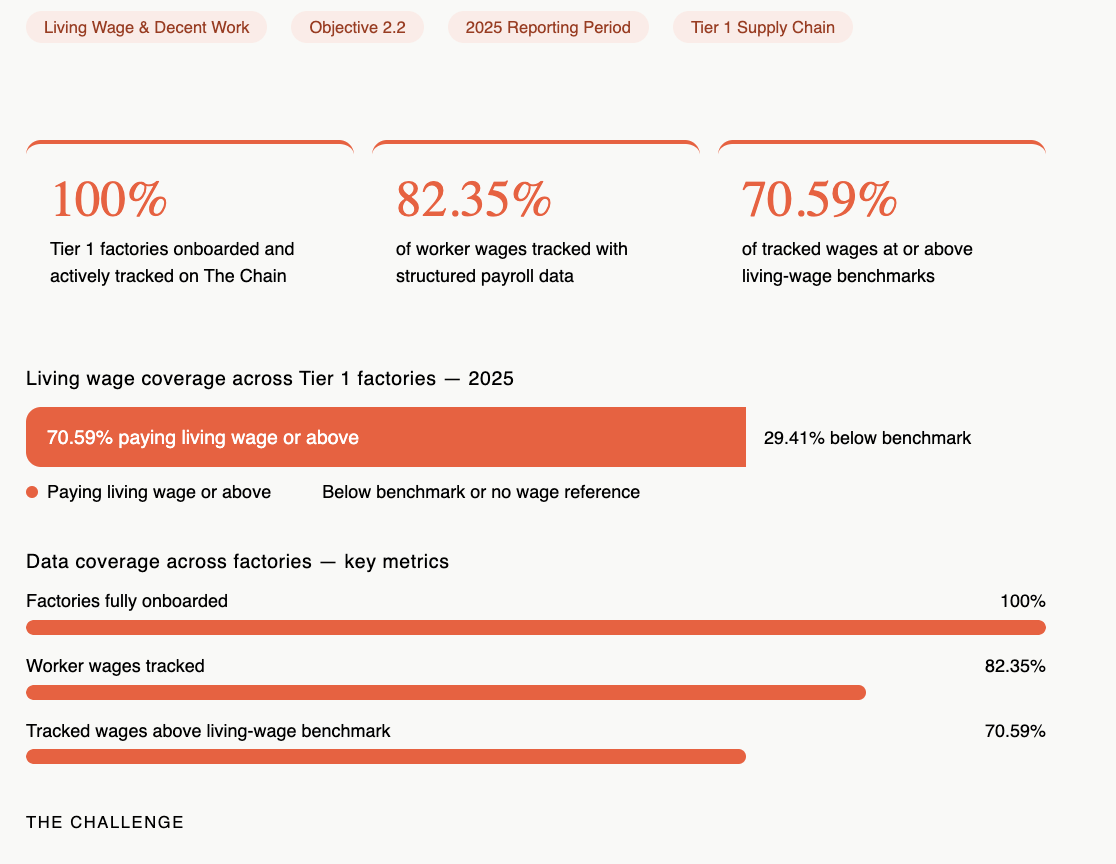
An infographic of Rat and Boa 2025 wage transparency progress, sourced from Rat and Boa 2025 Sustainability Report.
THE CHALLENGE
Before The Chain, wage data across Rat and Boa's supply chain existed in scattered formats, with no consistent structure and no basis for meaningful year-on-year comparison. Factories were cautious about disclosure. Without a shared view of the methodology or the outputs, transparency felt like exposure, a one-way audit rather than a mutual conversation.
The goal was not just to collect better data. It was to change the dynamic entirely, so that factories would see wage reporting as something they were part of rather than something done to them.
WHAT WE BUILT WITH THE CHAIN
We onboarded 100% of Tier 1 factories onto The Chain's wage tracking module. Each factory now uploads structured payroll data directly into the platform, creating a consistent, comparable record that builds in reliability over time. To strengthen this further, we introduced biannual wage assessments with all partner factories, improving reporting consistency, reducing data gaps, and making year-on-year comparison far more robust.
The Chain centralises all submissions in one place. That standardisation means every data point follows the same structure, the same verification process, and the same benchmarking logic. No manual reconciliation. No inconsistent formats.
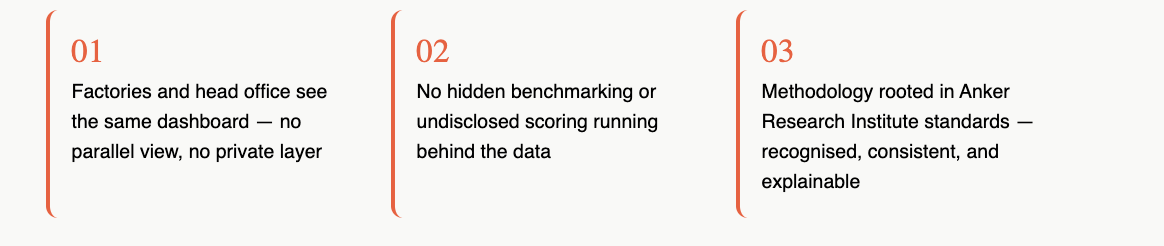
Crucially, the factories themselves have full access to their analysis dashboards, the same view that Rat and Boa's head office sees. There is no hidden scoring, no private benchmarking running in the background. The methodology is transparent, consistent, and grounded in the Anker Research Institute's living wage standards.
“
Factories have fed back that they feel more comfortable engaging in wage transparency because they see exactly the same analysis dashboards as head office. There is no hidden benchmarking or private scoring. This shared visibility has reduced fear around data sharing and created a more collaborative environment for discussion.”
WHY SHARED VISIBILITY CHANGED THE RELATIONSHIP
The most significant outcome was not the data itself. It was what the data made possible — a genuine shift in how factories and Rat and Boa relate to each other. Wage transparency has historically been a pressure point in supplier relationships. Factories often worry that sharing payroll data will lead to punitive scoring or reputational risk. The Chain removes that fear by design.
WHAT THE DATA IS SHOWING
Across the majority of sites, wages are increasing above inflation. That points to real-term wage growth rather than inflation-adjusted movement alone — a meaningful distinction when assessing whether worker purchasing power is actually improving.
Where wages remain below living wage benchmarks, this typically affects a small share of the workforce at those sites rather than being systemic across the entire factory. The granularity The Chain provides makes that distinction visible. Instead of broad assumptions about a factory's wage practices, the data surfaces exactly where the gaps are and how large they actually are.
“On minimum wage and living wage: Meeting the legal minimum wage satisfies a compliance threshold, but it does not always reflect the real cost of living. Workers earning at or near the minimum wage often rely on excessive overtime to cover basic needs. Closing the gap to a living wage is both a human rights priority and a supply chain stability issue. Factories with lower wage stress tend to have stronger worker retention and fewer disruptions.”
YEARLY PROGRESS WITH RAT AND BOA WITH THE CHAIN PLATFORM FOR WAGE TRANSPARENCY
2023
Initial wage data collection begins. 55% of the objective achieved. Baseline structures established across Tier 1 factories, but data quality and consistency remain variable.
2024
Progress reaches 75%. Factory onboarding increases and The Chain becomes the primary submission point for wage data across the supply chain.
2025
100% Tier 1 onboarding achieved. Biannual assessments introduced. 82.35% of worker wages now tracked. 70.59% of those wages above living-wage benchmarks. The work shifts from coverage to depth.
WHAT BRANDS NEED TO DO TO STAY COMPLIANT AND AHEAD
The regulatory landscape is shifting fast. The EU's Corporate Sustainability Reporting Directive (CSRD), incoming Digital Product Passport requirements under ESPR, and human rights due diligence legislation across Europe all point in the same direction: brands will need structured, verifiable, year-on-year wage data from their supply chain — not estimates, not narrative statements, but actual numbers tied to actual workers.
Here is what that readiness looks like in practice.
VISIBILITY: Map every Tier 1 factory and confirm you have a direct data channel with each one — not just a contact name but a structured reporting relationship
DATA STRUCTURE: Move from ad hoc wage surveys to structured payroll submissions. Data needs to be consistent in format, frequency, and benchmarking methodology to be usable year on year
BENCHMARKING: Understand the difference between minimum wage, adequate wage, and living wage in each country of production. Compliance sits at minimum wage. Credibility sits at living wage
SUPPLIER TRUST: Build a data-sharing environment where factories are not afraid to submit accurate figures. Punitive or opaque systems produce inaccurate data. Shared visibility produces honest data
REPORTING READINESS: Ensure your wage data can be extracted, formatted, and cited in sustainability reports, B Corp assessments, and due diligence questionnaires without manual reconstruction each cycle
DPP PREPARATION: Begin connecting wage data to product records now. EU Digital Product Passports will require traceability at the product level. Brands that build this infrastructure early will avoid a compliance scramble in 2027
HOW FRANK CO. & THE CHAN HELP BRANDS GET THERE
The work we did with Rat and Boa is repeatable. We built a system that works not because it demands more from suppliers, but because it gives suppliers something back, visibility, fairness, and a clear methodology. That is what makes factory engagement sustainable over time.
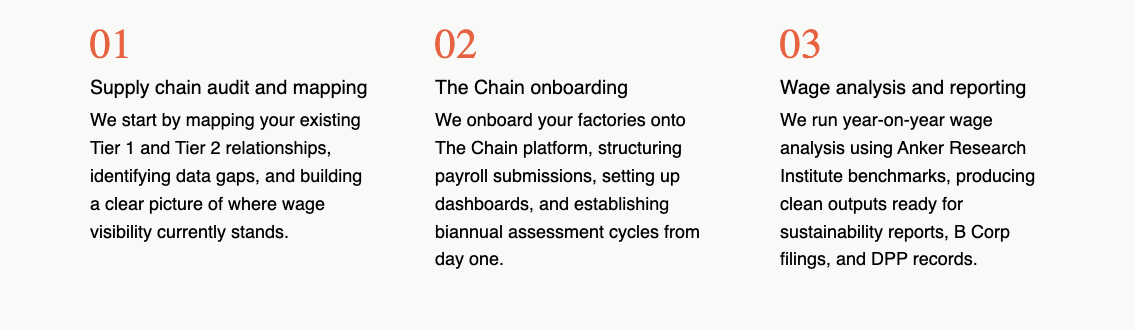
The Chain also provides brands with:
COMPLIANCE SUPPORT
We map your wage data against CSRD, ESPR, and human rights due diligence requirements — so you know exactly where you stand and what needs to change before deadlines arrive.
ONGOING CONSULTANCY
Frank Co works alongside your team as an embedded sustainability partner — not just for reporting cycles, but for the strategic decisions that shape your supply chain year on year.
READY TO BUILD WAGE TRANSPARENCY INTO YOUR SUPPLY CHAIN?
Whether you are starting from scratch or strengthening an existing programme, we can help you build a system that is credible, compliant, and built to last.